
Doitrous · Blog
Medical App Development in Egypt: Cost, Rules and Types
By Dr. Omar Yasser · Reviewed by Dr. Omar Yasser · Updated
Medical app development in Egypt means building a patient, clinic or telemedicine app that can lawfully hold health data. Budgets start around EGP 500,000 (about $10,000) for a general app and reach several million for complex telemedicine, and three rules shape scope: device registration, data protection and insurance integration.
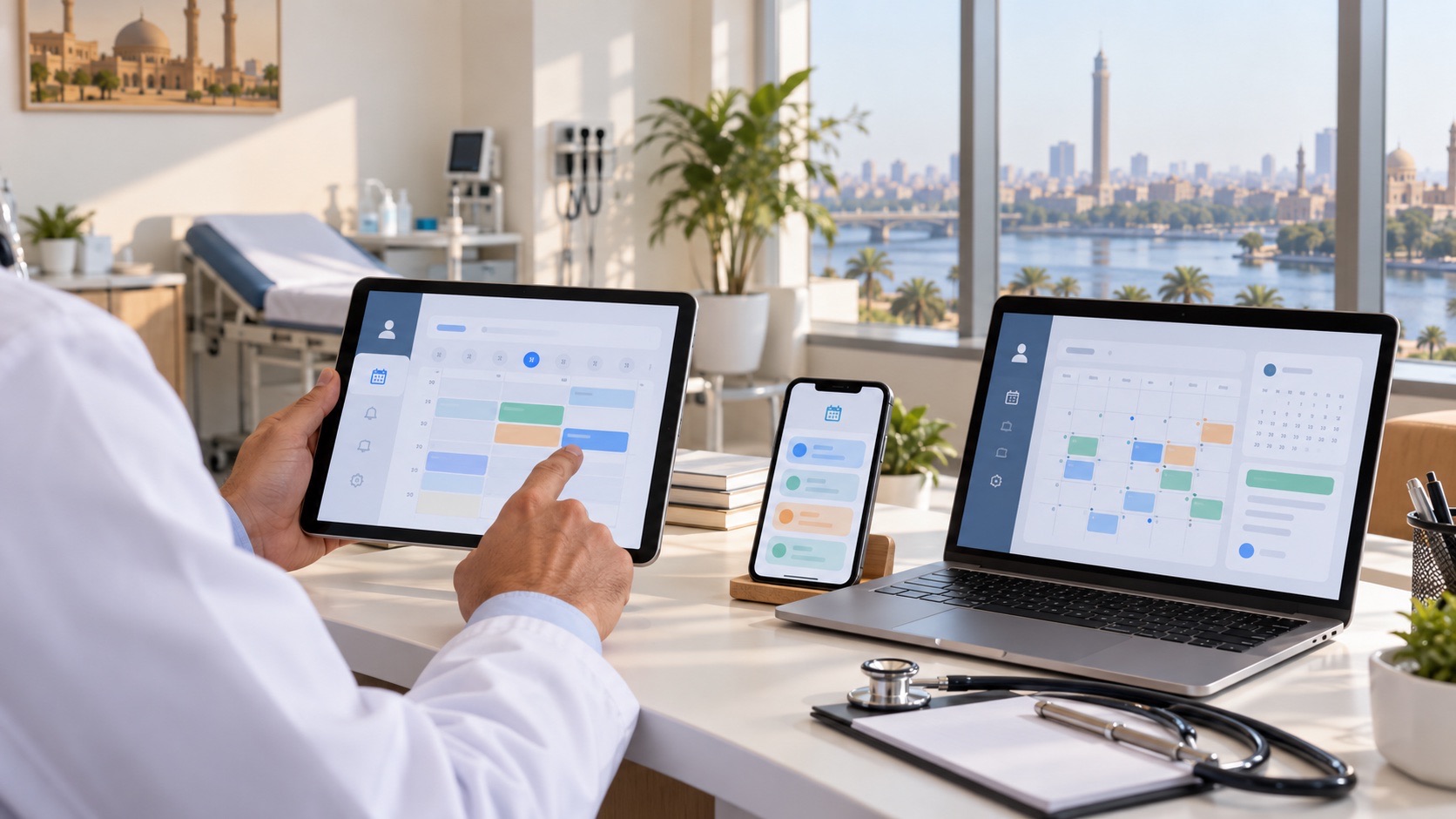
The Egypt-focused agency pages compared here treat healthcare as one industry in a long list, and none shows a healthcare price in EGP. The sections below separate the three common builds, price them in EGP, and flag the points that change for a medical product: device status, health-data law and insurance integration. It is written for clinic owners, doctor-founders and health-tech teams in Cairo, Giza and Alexandria.
Three kinds of medical apps you can commission
Appinventiv's Egypt page lists telemedicine and virtual consultation apps and clinic and hospital management apps as separate offerings, and that split matches how buyers scope the work. A patient app serves the person booking or following care, a clinic app serves staff, and a telemedicine app joins the two through remote consultations.
| App type | Main user | Check first |
|---|---|---|
| Patient app | Patients booking and following care | Health-data consent and Arabic and English right-to-left screens |
| Clinic or hospital management app | Doctors, reception and admin staff | Fit with existing records and, for insured patients, insurance access |
| Telemedicine app | Patient and doctor in a remote consultation | Telemedicine licensing rules, still developing in early 2024 |
For the staff-facing side of a larger facility, our hospital management system guide for Egypt covers what that kind of system involves.
A 2025 systematic review of 10 studies (2015-2024) found that telemedicine in Egypt has shown sustainability, while data privacy concerns and technology limits remain barriers. The same review reports that private hospitals are better equipped than government facilities, so private clinics and hospitals are the realistic first buyers of a telemedicine app.
What medical app development in Egypt costs
Public prices are scarce, and none of them is a quote for your project. Apptunix, a mobile app agency, says app development in Egypt typically costs $10,000 to $50,000+ (roughly EGP 500,000 to EGP 2,500,000+) and takes 3 to 10 months. Its page lists 2 to 3 months for simple apps, 4 to 6 months for mid-level apps and 6 to 12+ months for complex enterprise or AI-powered apps. Appinventiv's Egypt page lists healthcare services but shows no healthcare pricing.
| Source | Scope | Price | Timeline |
|---|---|---|---|
| Apptunix, Egypt page, October 2026 | General mobile app | $10,000 to $50,000+ (roughly EGP 500,000 to EGP 2,500,000+) | 3 to 10 months |
| Intelivita, May 2024 | Simple telemedicine app | $30,000 to $60,000 (about EGP 1.5 to 3 million) | 3 to 6 months |
| Intelivita, May 2024 | Complex telemedicine app | $150,000 to $300,000+ (about EGP 7.5 to 15 million+) | 9 to 12 months or more |
Intelivita is a Western agency, so its figures are not Cairo quotes. The EGP amounts for its ranges are converted here at the EGP 50 per dollar rate implied by Apptunix's own conversion, so treat them as ballpark and re-check the exchange rate before budgeting. Intelivita's guide names six cost drivers: complexity and features, regulatory compliance and security, platform and technology choices, user experience design, team expertise, and post-launch support.
Does your app need Egyptian Drug Authority registration?
The Egyptian Drug Authority (EDA) expanded registration in 2018 to cover all medical devices, with certain exceptions, and a foreign manufacturer with no presence in Egypt must appoint a local representative. Whether an app counts as a device turns on its intended medical purpose. The FDA, citing the IMDRF, defines Software as a Medical Device as software intended for one or more medical purposes that does so without being part of a hardware medical device.
So the question is not whether the product is an app but what it is meant to do for the patient. None of the EDA-related sources reviewed address software-only devices, including a 2026 consultancy guide that describes ISO 13485:2016 as mandatory for applicants. Describe the app's purpose to the EDA and get its written position before launching any feature that diagnoses, monitors or recommends treatment.
Health data and the Personal Data Protection Law
The law firm CMS reports that the Executive Regulations of Egypt's Personal Data Protection Law (Law 151/2020) were issued as Ministerial Decision 816/2025, dated 1 November 2025, and started a one-year compliance period that on a strict reading ends on 1 November 2026. Three points matter for an app that holds patient records:
- Sensitive personal data carries enhanced protections and written consent requirements, so ask your lawyer whether patient records fall into that category.
- Controllers and processors must notify the Personal Data Protection Center within 72 hours of becoming aware of a personal data breach.
- The Center released Licences and Permits Guidelines version 1.1 on 26 January 2026, which your lawyer should read before launch.
Appinventiv and Apptunix both name the law on their Egypt pages, but neither explains what it asks of a health app. Ask any build team how consent, audit logs and breach response will be designed, not only whether the app is called compliant. Have counsel confirm the dates, because this summary comes from a law firm's note and not from the regulator.
Telemedicine rules, insurance and mobile reach
A February 2024 review by the law firm Andersen said rules specific to telemedicine in Egypt were still being developed, and that medical negligence over telemedicine had not yet reached Egyptian courts. Treat the licensing position as unsettled and check it again at launch.
Insurance integration is moving faster. On 3 June 2025 the Ministry of Health and Population signed an agreement with eHealth, a private investment company, to operate and manage the national digital health system, including access for private-sector technology providers to the Universal Health Insurance System (UHIS), as reported by Amwal Al Ghad. Egypt then unveiled its National Digital Health Strategy 2025-2029 on 15 November 2025, aiming for a fully digitised health system by 2029, according to Ecofin Agency. A clinic or hospital app that expects insured patients should plan its integration through eHealth.
The Information and Decision Support Center put Egypt's mobile internet subscriptions at 92.6 million in December 2025, or 75.3% of mobile subscribers, so design the patient side mobile-first.
Custom app or an existing platform?
Vezeeta launched in Cairo in 2012 as a doctor search and booking platform and added ePharmacy and tele-health products in 2020, so the booking-plus-telehealth model already exists in Egypt. If you only need your doctors listed and bookable, joining a platform is the lighter option. A custom app earns its cost when you need your own patient relationship, your own workflows, or links to your clinic system.
How to brief a build team
- Name the app type and the first user group.
- State the app's intended medical purpose in one sentence, so the device question can be answered.
- List the health data it will hold and where it will be hosted.
- Say whether insurance patients must be supported through UHIS.
- Require Arabic and English right-to-left screens, designed for phones first.
- Ask for a scoped quote with a timeline, not a headline price.
If you are still comparing build teams, see our guide to choosing a custom healthcare software development partner.
Frequently asked questions
How much does it cost to develop a medical app in Egypt?
The Egypt agency pages compared show no healthcare price list. Apptunix cites $10,000 to $50,000+ (roughly EGP 500,000 to EGP 2,500,000+) for app development in Egypt generally, while Intelivita's May 2024 telemedicine guide gives $30,000 to $300,000 or more (about EGP 1.5 to 15 million). Scope, compliance and platform choices decide where a project lands.
How long does it take to build a telemedicine app?
Intelivita puts simple telemedicine apps at 3 to 6 months and complex ones at 9 to 12 months or more. Apptunix's Egypt page lists 2 to 3 months for simple apps, 4 to 6 for mid-level and 6 to 12+ for complex enterprise or AI-powered apps. Plan time for the device-status and data-protection checks as well.
Do I need Egyptian Drug Authority approval for a medical app?
It depends on the app's intended medical purpose. The EDA has required registration for all medical devices, with certain exceptions, since 2018, and the FDA treats software with a medical purpose as a device. The sources reviewed do not address software-only devices in Egypt, so confirm your app's status with the EDA in writing before launch.
Is telemedicine legal in Egypt?
A February 2024 law-firm review said rules specific to telemedicine were still being developed, and that medical negligence over telemedicine had not yet reached Egyptian courts. Treat the area as unsettled, ask a healthcare lawyer for the current position before launch, and design consent and record-keeping conservatively.
Can a medical app connect to Egypt's Universal Health Insurance System?
The June 2025 agreement between the Ministry of Health and Population and eHealth includes access to the Universal Health Insurance System for private-sector technology providers. A clinic or hospital app would use that route, so raise eHealth integration early in scoping rather than after the build.
Next step
Written by Dr. Omar Yasser. If you are scoping a medical app, Contact us with the app type, the user group and the health data you expect to hold, and we will help you frame the brief. The first conversation covers the intended medical purpose, where the data will be hosted, whether insured patients must be supported, and a scoped quote with a timeline.
Frequently asked questions
How much does it cost to develop a medical app in Egypt?
The Egypt agency pages compared show no healthcare price list. Apptunix cites $10,000 to $50,000+ (roughly EGP 500,000 to EGP 2,500,000+) for app development in Egypt generally, while Intelivita's May 2024 telemedicine guide gives $30,000 to $300,000 or more (about EGP 1.5 to 15 million). Scope, compliance and platform choices decide where a project lands.
How long does it take to build a telemedicine app?
Intelivita puts simple telemedicine apps at 3 to 6 months and complex ones at 9 to 12 months or more. Apptunix's Egypt page lists 2 to 3 months for simple apps, 4 to 6 for mid-level and 6 to 12+ for complex enterprise or AI-powered apps. Plan time for the device-status and data-protection checks as well.
Do I need Egyptian Drug Authority approval for a medical app?
It depends on the app's intended medical purpose. The EDA has required registration for all medical devices, with certain exceptions, since 2018, and the FDA treats software with a medical purpose as a device. The sources reviewed do not address software-only devices in Egypt, so confirm your app's status with the EDA in writing before launch.
Is telemedicine legal in Egypt?
A February 2024 law-firm review said rules specific to telemedicine were still being developed, and that medical negligence over telemedicine had not yet reached Egyptian courts. Treat the area as unsettled, ask a healthcare lawyer for the current position before launch, and design consent and record-keeping conservatively.
Can a medical app connect to Egypt's Universal Health Insurance System?
The June 2025 agreement between the Ministry of Health and Population and eHealth includes access to the Universal Health Insurance System for private-sector technology providers. A clinic or hospital app would use that route, so raise eHealth integration early in scoping rather than after the build.